
Exploring the earliest steps of animal domestication through innovative biogeochemical research in the Fertile Crescent.
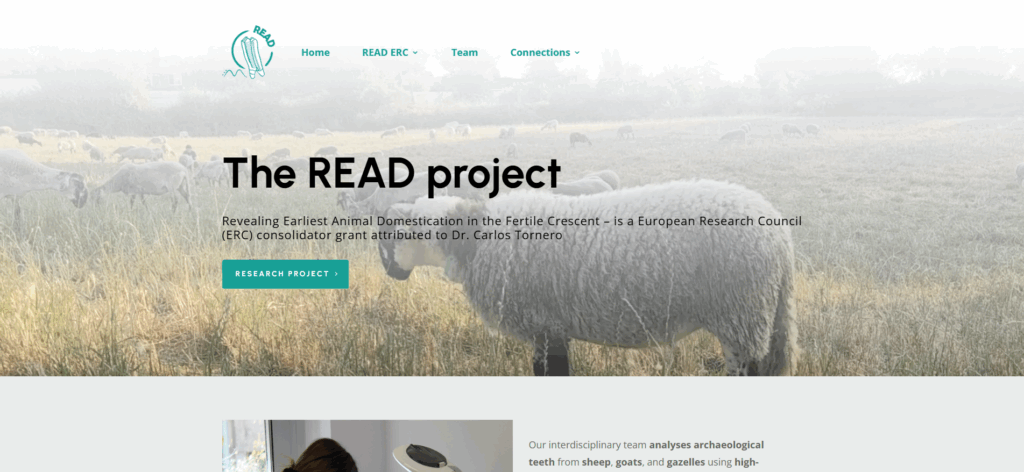
We are pleased to introduce the new webpage of the READ project (Revealing Earliest Animal Domestication in the Fertile Crescent), an ERC Consolidator Grant (2024–2028) led by Dr. Carlos Tornero at the Universitat Autònoma de Barcelona (UAB).
Although the project began in January 2024, this site now launches as a platform to share our work with the wider community. Here, you will find updates on our research activities, news from the field and the lab, details of our collaborations, and the results as they emerge.
READ seeks to transform how we understand the origins of animal domestication—one of the key turning points in human history. Instead of relying solely on morphological changes in archaeological bones, our approach uses high-resolution biogeochemical analyses of fossil teeth to reveal the earliest management of sheep and goats. By tracking reproductive control, feeding strategies, and seasonal mobility, we aim to detect the subtle practices that preceded full domestication.
Our field and analytical work focuses on Neolithic sites across the Southern Levant, Northern Levant, and Eastern Fertile Crescent, complemented by comparative datasets built from modern and museum collections of wild relatives. The project is carried out in partnership with a broad international network of research institutions and laboratories, uniting expertise in archaeology, isotope geochemistry, paleoecology, and natural history collections across Europe and North America.
Over the coming years, this site will become the hub for sharing our journey: from field campaigns and laboratory analyses to conferences, publications, and outreach activities.
We also invite you to follow us on Instagram and X (Twitter), where we’ll be posting more frequent updates and snapshots of our research in action.
Join us as we work to reveal the earliest chapters of human–animal relationships.

Latest news
ERC-READ Researchers Share Insights on Sheep Domestication at JIA 2024
Highlights from the team’s presentations on experimental herds, tooth enamel chemistry, and...
Shaping the Herd: Early Evidence of Caprine Management at Tell Halula
At the ASWA 2025 meeting in Munich, Roger Alcàntara Fors presented new insights into early goat...
Rethinking Animal Domestication at Abu Hureyra: 50 Years Later
On 30 April 2025, Dr. Carlos Tornero revisited the landmark excavations at Abu Hureyra, Syria, and...
Recent Honors for Carlos Tornero: Academia Joven de España and Professorship at UAB
In 2024, Carlos Tornero was appointed as a full member of the Young Academy of Spain and promoted...
Public Lecture: Exploring the Origins of Animal Domestication in the Near East
On 6 March 2024, Dr. Carlos Tornero presented the latest insights from the ERC READ project at the...
ERC Consolidator Grant Awarded to Launch the READ Project
The European Research Council has awarded nearly €2 million to Dr. Carlos Tornero (UAB) to lead...