
On 6 March 2024, Dr. Carlos Tornero presented the latest insights from the ERC READ project at the Universitat de València.
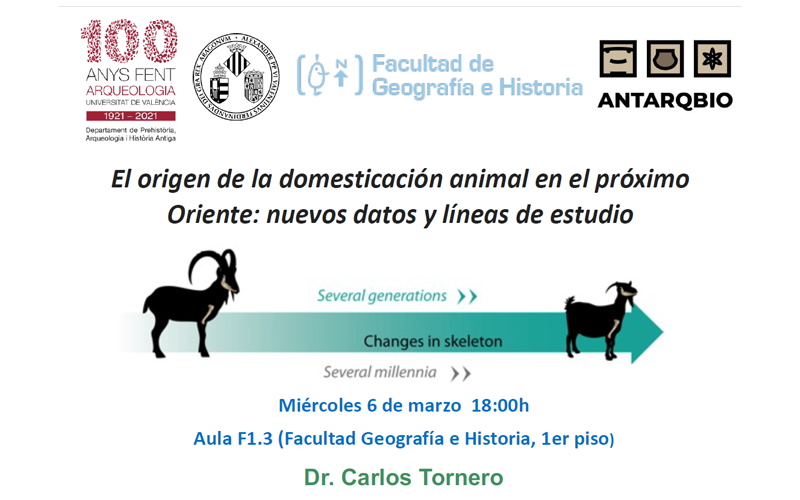
The Neolithic period marked one of the great turning points in human history. The domestication of the first livestock species not only transformed subsistence economies, but also reshaped the very structure of human societies. On 6 March 2024, Dr. Carlos Tornero, Principal Investigator of the ERC Consolidator Grant READ, delivered a lecture entitled “El origen de la domesticación animal en el Próximo Oriente: nuevos datos y líneas de estudio” at the Facultad de Geografía e Historia, Universitat de València, within the ANTARQBIO Seminar Series (Course 23–24).
In his talk, Dr. Tornero highlighted the limitations of traditional zooarchaeological approaches to detecting domestication, which often rely on morphological changes in animal remains—markers that typically appear centuries after management practices were already underway. He presented the biogeochemical strategies at the heart of READ, designed to uncover earlier and subtler signals of human intervention in animal life histories:
- Reproductive control
- Shifts in diet and feeding practices
- Restrictions on seasonal mobility
By integrating isotopic and biogeochemical analysis of fossil teeth, READ aims to reveal how Neolithic communities across the Fertile Crescent gradually reshaped their relationship with animals, long before the classic markers of domestication appeared.
The event was hosted by Dr. Domingo Carlos Salazar García (Universitat de València) and sparked discussion among attendees about the implications of these new methods for understanding one of the most profound transitions in human prehistory.
For more news and upcoming talks from the READ project, stay tuned here on our webpage and follow us on Instagram and X (Twitter) for updates from the field and the lab.
Latest news
ERC-READ Researchers Share Insights on Sheep Domestication at JIA 2024
Highlights from the team’s presentations on experimental herds, tooth enamel chemistry, and...
Shaping the Herd: Early Evidence of Caprine Management at Tell Halula
At the ASWA 2025 meeting in Munich, Roger Alcàntara Fors presented new insights into early goat...
Rethinking Animal Domestication at Abu Hureyra: 50 Years Later
On 30 April 2025, Dr. Carlos Tornero revisited the landmark excavations at Abu Hureyra, Syria, and...
Recent Honors for Carlos Tornero: Academia Joven de España and Professorship at UAB
In 2024, Carlos Tornero was appointed as a full member of the Young Academy of Spain and promoted...
Welcome to the ERC READ Project Website
Exploring the earliest steps of animal domestication through innovative biogeochemical research in...
ERC Consolidator Grant Awarded to Launch the READ Project
The European Research Council has awarded nearly €2 million to Dr. Carlos Tornero (UAB) to lead...